Abadie 500 Block Single Wide
UGX 6,500Abadie is a historic French brand, and their 500-block is a legendary product for serious rollers. This massive block contains 500 sheets of high-quality, medium-weight paper, making it one of…
+256787568587
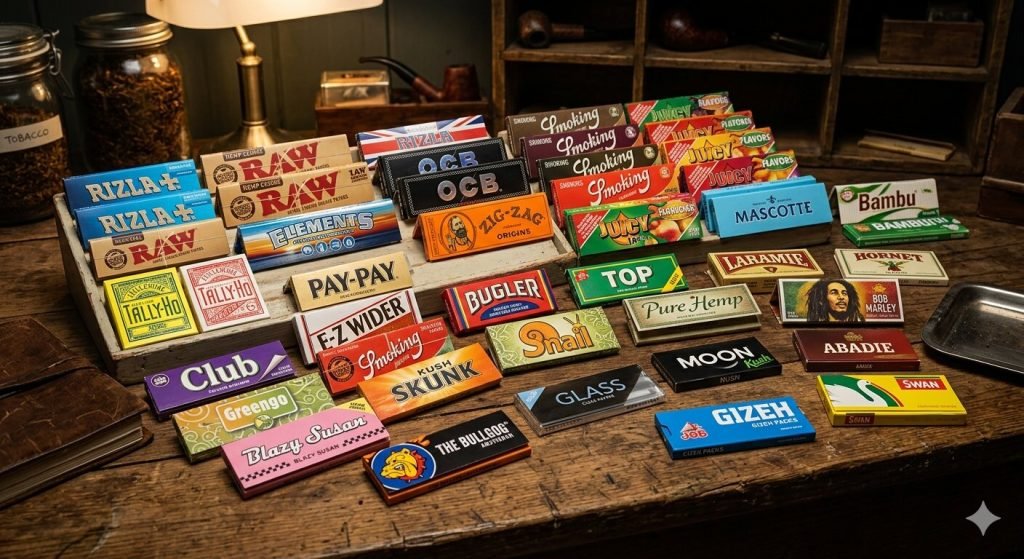
For thousands of years, the ritual of preparing and consuming botanicals has evolved alongside human innovation. What once relied on crude plant leaves or heavy stone tools has transformed into a multi-million dollar precision industry. Today, structural physics, metallurgy, material science, and paper engineering intersect to create the tools used by enthusiasts worldwide.
Whether you are a retail store owner looking to expand your inventory, a processing facility optimizing production, or an individual enthusiast wanting to improve your rolling technique, navigating the massive array of options can be overwhelming.
This comprehensive technical guide breaks down the core concepts behind rolling papers, pre-rolled cones, and herb grinders, offering detailed answers to the most frequently asked questions in the industry.
The history of commercial rolling papers dates back to the 16th century in Europe. Originally, smokers reused discarded scraps of heavy printing paper or newspaper. However, the intake of toxic inks and thick wood pulps led to the creation of dedicated paper mills.
In 1532, a Frenchman named Lacroix traded a bottle of fine champagne for a batch of high-quality rolling papers, marking the birth of what would become a legendary enterprise. By 1736, the Lacroix family acquired their own paper mill, establishing the Lacroix Rolling Paper Company.
The real breakthrough came in 1860 when the company shifted from traditional wood pulps to paper made from rice fibers. This invention transformed the brand. They combined “Riz” (the French word for rice) with “La+” (abbreviated for Lacroix, meaning “The Cross”), creating the world-renowned name: Rizla. Today, the brand continues to lead the global market by engineering papers from a wide range of organic materials.
The raw materials used to make rolling paper directly influence the temperature of the burn, the amount of residue left behind, and the overall flavor profile.
+-------------------+--------------------+-----------------------+---------------------+
|   Paper Material  | Relative Burn Rate | Combustion Ash Volume | Flavor Interference |
+-------------------+--------------------+-----------------------+---------------------+
| Classic Wood Pulp | Fast-Burning       | Heavy White Ash       | Moderate / Sweet    |
| Organic Hemp      | Medium-to-Slow     | Light Gray Ash        | Earthy / Herbal     |
| Pure Rice Fiber   | Ultra-Slow         | Near-Zero Residue     | Neutral / Crisp     |
| Natural Bamboo    | Slow-Burning       | Minimal Gray Ash      | Clean / Ultra-Light |
+-------------------+--------------------+-----------------------+---------------------+
In paper engineering, weight and thickness are measured in GSM (Grams per Square Meter).
The rolling paper industry uses a set of standard sizes to help consumers match their papers with their preferred filling capacities:
[====== Single Wide: 68-70mm x 34-36mm ======]
[======== 1 1/4 Size: 76-78mm x 44-48mm ========]
[========== King Size Slim: 108-110mm x 42-46mm ==========]
To ensure a secure, permanent seal, premium brands use an adhesive strip made from natural water-soluble gums. The most common choice is Gum Arabic, sourced from the sap of the wild African Acacia tree.
Some brands substitute this with organic Sugar Gum derivatives. When lightly moistened, these natural gums become tacky, creating a firm bond that burns cleanly without releasing toxic chemical fumes or harsh synthetic odors.
Pre-rolled cones are manufactured by wrapping rolling paper around a mandrel and sealing it with a food-grade adhesive. A paper filter tip is then inserted into the narrow base.
   (Wider Opening: Slow, Low-Velocity Draw)             (Narrow Base / Filter)
    \========================================================/----------|
     \                                                       /          |
      \======================================================\----------|
                        DIRECTION OF THERMAL AIRFLOW <===
From a fluid dynamics perspective, the conical shape offers a major advantage over a standard cylindrical roll. The wider opening holds a larger volume of material, which burns at a slower, lower-velocity pace.
As you draw air through the cone, the smoke cools slightly as it travels down the narrowing channel toward the filter tip. This shape helps maintain a balanced, smooth airflow throughout the entire session.
Pre-rolled cones are classified by their overall length and the length of their built-in filter tip. Standard options include:
The premium cone market has expanded far beyond traditional papers to include unique botanical options:
For licensed manufacturers, filling individual cones by hand is highly inefficient. Commercial processing centers rely on automated filling machines (such as the Thousand Cones or Knockbox platforms) to scale up operations.
The filling process follows four key steps:
[ STEP 1: CONE LOADING ]     --> Vibratory tray settles hundreds of empty cones into tight alignment.
           |
           v
[ STEP 2: AGGREGATE INPUT ]  --> Ground herb material is spread evenly across the top loading deck.
           |
           v
[ STEP 3: VIBRATORY COMPACTION ] -> Mechanical tapping forces material down to eliminate air pockets.
           |
           v
[ STEP 4: VOLUMETRIC TAMPING ] -> Pneumatic pins press down on each cone to lock in a uniform pack.
This automated workflow allows a single operator to fill, pack, and seal thousands of uniform, retail-ready cones every hour, keeping labor costs low and ensuring consistent product weight.
Filter tips do more than just block loose herbal particles from entering your mouth; they provide structural stability to the base of the paper cone.
Using your fingers to tear dry herbs bruises the delicate plant tissues and leaves behind sticky, valuable resins on your skin. A mechanical herb grinder uses sharp, intersecting teeth to slice the material cleanly.
This process preserves the plant’s essential oils while creating a light, airy texture with a consistent particle size. This uniform grind allows air to flow smoothly through your papers or cones, ensuring an even, controlled burn.
Grinders are built using modular, interlocking layers to manage different stages of the processing cycle:
+-------------------------------------------------------------+
| 1. TOP CAP LAYER     [ Integrated Slicing Teeth ]          |
+-------------------------------------------------------------+
| 2. GRINDING CHAMBER  [ Intersecting Teeth + Drop Holes ]    |
+-------------------------------------------------------------+
| 3. STORAGE VAULT     [ Stainless Steel Mesh Screen ]        |
+-------------------------------------------------------------+
| 4. COLLECTION BASE   [ Micro-Resin Catch Pot ]              |
+-------------------------------------------------------------+
The shape of a grinder’s teeth determines whether it shears the material cleanly or crushes it forcefully:
    /\        /\             ---        ---            |    |
   /  \      /  \           /   \      /   \           |    |
  /====\    /====\         /=====\    /=====\          |____|
  [ DIAMOND-CUT ]          [ TRAPEZOIDAL ]          [ PIN-TEETH ]
 Sharp shearing edge.    Aggressive shredding.     Basic crushing action.
Over time, sticky plant resins accumulate along the edges and teeth of your grinder, causing it to stick or jam. To restore smooth operation, follow this cleaning process:
“Canoeing” occurs when one side of your rolling paper burns significantly faster than the other, wasting your material and ruining the session.
CANOEING EFFECT (Bad, Uneven Thermal Airflow)
    _________________________________
   /     BURNING FAST (Top Side)     \______ (Fire runs down one side)
  (________________________________________/
         SLOW SMOLDERING (Bottom Side)
This frustrating issue is typically caused by three common factors:
Because premium rolling papers are engineered to be thin, they are highly sensitive to changes in the surrounding air:
Use this quick-reference guide to select the right tools based on your specific requirements:
| Intended Goal | Recommended Product | Key Material | Advantages |
| Purity of Taste | Rizla Natura / Bamboo | Pure Bamboo / Rice Fiber | Near-zero ash production; completely neutral flavor profile. |
| Ease for Beginners | King Size Red Label | Classic Wood Pulp (Heavy) | High tensile strength; easy to roll without tearing. |
| High-Volume Production | Pre-Rolled 109mm Cones | Unbleached European Hemp | Consistent dimensions; optimized for automated filling trays. |
| Eco-Conscious Choice | Organic Hemp 1 1/4 | 100% Unbleached Organic Hemp | Clean burn; sustainably sourced raw plant fibers. |
| User Profile | Recommended Structure | Material Type | Key Features |
| On-The-Go Travel | 2-Piece Compact | Polycarbonate / Acrylic | Lightweight, inexpensive, and easy to pack without spilling. |
| Resin Collection | 4-Piece Modular | 6061-T6 Anodized Aluminum | Built-in micron mesh screen with a dedicated bottom tray. |
| Commercial Processing | 3-Piece Heavy Duty | Medical-Grade Stainless Steel | Razor-sharp teeth with large drop holes for fast, continuous volume. |
Showing 1–16 of 203 results
Abadie is a historic French brand, and their 500-block is a legendary product for serious rollers. This massive block contains 500 sheets of high-quality, medium-weight paper, making it one of…
These filter tips contain activated carbon to remove impurities and cool down the smoke for a much smoother experience. This wholesale box is perfect for health-conscious customers. They are a…
A rugged, waterproof, and airtight plastic box designed for the roughest conditions. Whether you are hiking or camping, this stash box keeps your herbs and papers dry and protected. It…
Crafted from sustainable bamboo, this rolling station features carved slots for all your accessories. It includes a dedicated spot for your grinder, paper dispenser, and even a hole for your…
A small, eco-friendly bamboo tray for those with limited space. It features the same high-quality finish as our larger bamboo stations but in a compact, portable size that fits perfectly…
Bambu Classic Regular papers have been a mainstay in the New York smoking scene for decades, famous for their high-quality wood pulp composition and natural gum. These papers are slightly…
The 1 1/4 size of Blazy Susan’s famous pink papers offers the same vegan and non-GMO quality in a traditional format. These are made in France and provide a smooth,…
This Blazy Susan pack includes the famous pink 1 1/4 papers and a set of matching pink tips in one convenient pack. Like all their products, these are vegan and…
Blazy Susan has taken the market by storm with their signature pink rolling papers. Made in France from high-quality wood pulp, these papers are vegan and non-GMO. Despite the vibrant…
This Blazy Susan pack includes the famous pink king size slim papers and a set of matching pink tips in one stylish pack. Like all their products, these are vegan…
For those who don’t want to roll, Blazy Susan offers their signature pink papers in pre-rolled cone format. These come with a built-in tip and just need to be filled….
Blazy Susan also offers their signature pink paper in a 5-meter roll, allowing for total customization of length. Like the sheets, the rolls are vegan, non-GMO, and made from premium…
The 1 1/4 size of Bob Marley Pure Hemp papers offers the same natural quality as the king size but in a more traditional format. These papers are perfect for…
Officially licensed Bob Marley Pure Hemp papers celebrate the legacy of the reggae icon with high-quality, natural hemp construction. Each pack features different inspirational quotes and images of Bob Marley,…
Buy wholesale brown organic rolling papers in bulk with this 50-pack display box. These papers are unbleached and chlorine-free, providing a clean and natural smoking experience. This is a high-demand…
Bugler papers are traditionally associated with roll-your-own tobacco kits, offering a medium-weight paper that mimics the feel of a traditional cigarette. These papers are designed to stay lit and provide…